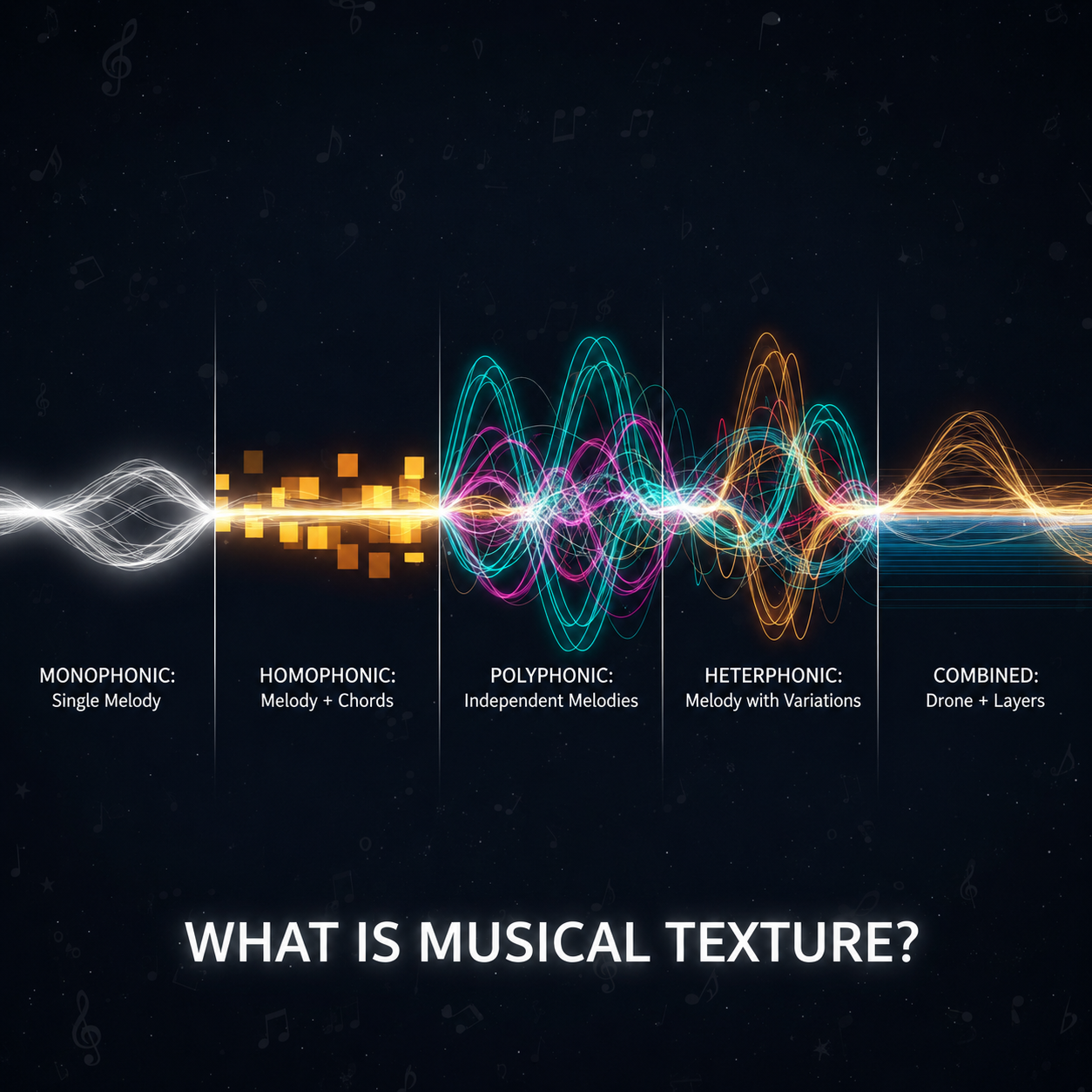
What is Texture in Music?
Musical texture describes how different sounds and musical lines combine with each other. In other words: how many voices are playing at the same time? Are they independent or just supporting? Do they move in the same rhythm or in different ones? The answers define whether the texture is monophonic, homophonic, polyphonic, heterophonic, and so on.
Key Parameters that Shape Texture
- Number of lines/voices (one, two, many)
- Independence of the lines (is each a melody, or are some just accompaniment?)
- Melody ⇄ Harmony relationship (is there a clear melody, or are all voices equal?)
- Rhythmic relationship (same rhythm vs. contrasting rhythms)
- Density/thickness (thin → one line; thick → full orchestra)
- Range distribution (all in one register, or spread across bass/mid/treble)
- Timbre (tone color) — which instruments/voices are combined
Main Types of Musical Texture
1) Monophonic Texture (Single-line)
- Definition: Only one melody line, with no harmony or accompaniment. Even if doubled in octaves, it is still monophonic.
- Listening clue: You hear just one line — the whole attention is on it.
- Example (notation): Melody:
C4 — D4 — E4 — F4 — G4 - Familiar cases: Solo voice unaccompanied, Gregorian chant, a lone tar playing in Persian radif.
2) Homophonic Texture
- Definition: A main melody with harmonic or rhythmic accompaniment.
- Subtypes:
- Melody-dominated homophony: singer/lead melody in front, chords behind (pop songs).
- Homorhythmic texture: all voices move with the same rhythm, forming chords (choral style).
- Listening clue: Clear foreground melody, background harmony.
- Example (notation):
- Melody:
E4 — F#4 — G4 — A4 - Chords:
| C | G | Am | F | - Familiar cases: Most pop, rock, and classical songs. In Persian pop: a singer with piano/guitar chords.
3) Polyphonic (Contrapuntal) Texture
- Definition: Several independent melodies sounding together, each with its own importance. Counterpoint is a strict, rule-based form of polyphony.
- Listening clue: You hear “dialogue” between lines, often imitating or overlapping.
- Example (canon with two voices):
- Line A:
C4 — D4 — E4 — F4 — G4 - Line B (enters later): same as A
- Familiar cases: Bach’s fugues, Renaissance vocal works, some Persian orchestral/modern compositions.
4) Heterophonic Texture
- Definition: Two or more performers play (or sing) essentially the same melody, but with slight variations (ornaments, rhythm, interval changes).
- Listening clue: The overall shape is one melody, but each performer decorates it differently.
- Example:
- Base melody:
C4 — D4 — E4 — D4 — C4 - Variation:
C4 — (grace) D4 — E4 (trill) — D4 — C4 - Familiar cases: Traditional Middle Eastern and Persian music — e.g., when a tar, kamancheh, and a singer perform the same line with unique ornaments.
5) Other / Combined Textures
- Drone / Pedal point: one sustained note underneath (e.g., bagpipe drone, Persian ney with a held note).
- Ostinato texture: a repeating rhythmic or melodic pattern beneath other layers.
- Layered texture: typical in electronic music — bass line, drum pattern, pads, melody, each as a layer.
- Polyrhythmic texture: multiple contrasting rhythms at once (African drumming, modern jazz).
How to Analyze or Identify Texture (Step by Step)
- Is there one clear melody only? → Monophonic.
- Is there one melody with accompaniment chords? → Homophonic.
- Do you hear several independent melodies? → Polyphonic.
- Do performers play the same melody but with slight variations? → Heterophonic.
- Is there a sustained drone note beneath? → Drone texture.
- Are all voices moving in the same rhythm? → Homorhythm texture.
- How dense is it? Thin vs. thick.
Practical Tips for Composers, Arrangers & Producers
- For thin texture: use solo melody or minimal accompaniment.
- For thick texture: add layers — bass, chords, pads, counter-melodies.
- For polyphony: write independent lines with different rhythms; control dissonance carefully.
- For heterophony: give the same melody to different instruments/voices but let each decorate differently.
- In mixing: pan and EQ to separate lines (helps polyphony clarity); keep accompaniment lower in reverb/depth so the main melody stays forward.
Listening Exercises (Ear Training)
- Listen to a pop song — is it homophonic? (usually yes).
- Listen to a Persian radif piece with two instruments — heterophony likely.
- Listen to a Bach fugue — try following each independent line (polyphony).
- Sing a melody and accompany yourself with guitar chords — feel homophony.
- Hold a drone note on keyboard while playing a melody above — feel how texture changes.
Quick Summary — “Checklist”
- One line only → Monophonic
- Melody + chordal accompaniment → Homophonic
- Several independent melodies → Polyphonic
- One melody with simultaneous variations → Heterophonic
- Sustained note beneath → Drone texture
- Repeated pattern beneath → Ostinato texture