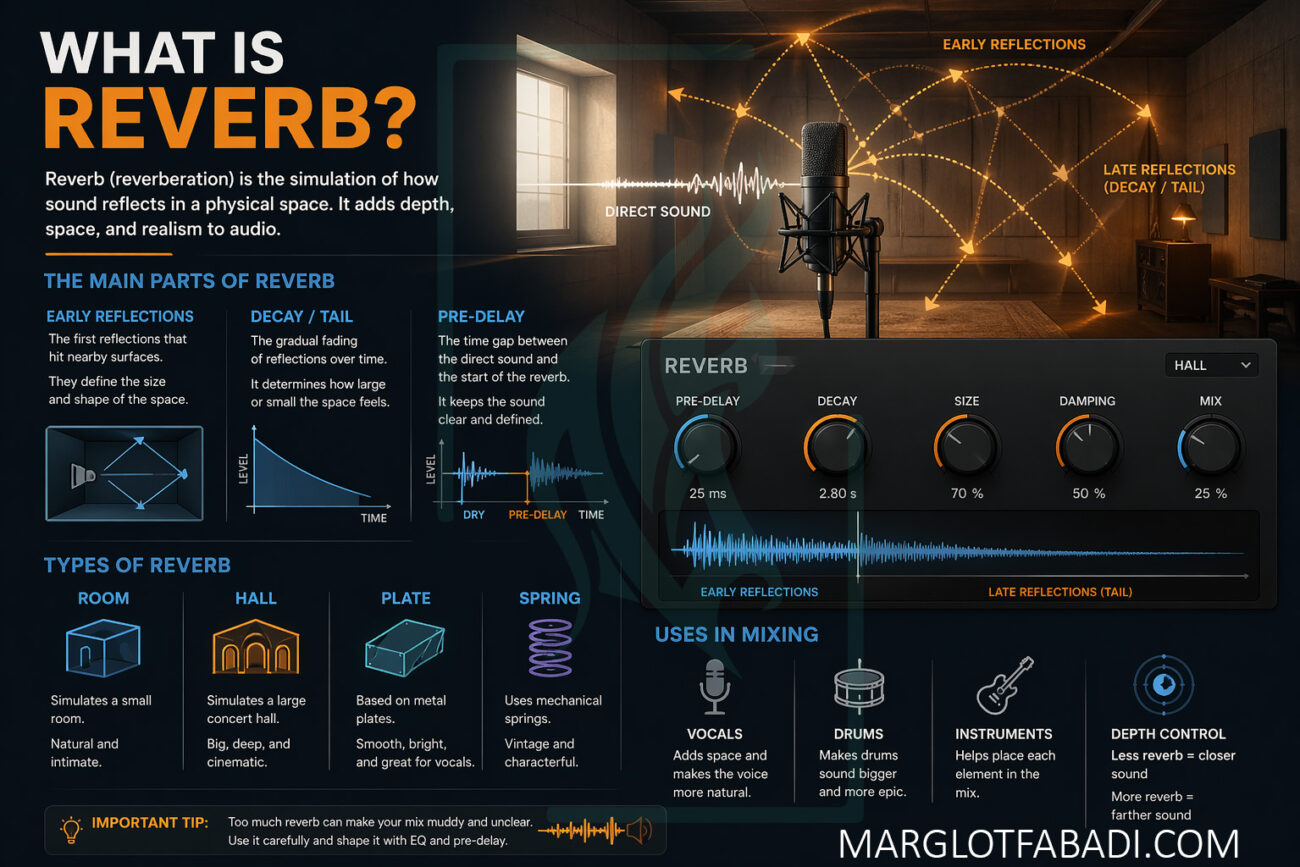
What is Reverb in Audio?
Clear and Simple Definition
Reverb (short for reverberation) is the simulation of how sound reflects within a physical space.
When a sound is produced (like a clap), it doesn’t just reach your ears directly—it also bounces off walls, ceilings, and floors, returning with tiny delays. The combination of all these reflections is what we perceive as reverb.
Key Components of Reverb
- 1. Early Reflections
- The first reflections that hit nearby surfaces.
- 👉 They help your brain understand the size and shape of the space.
- 2. Decay / Tail
- The gradual fading of the reflections over time.
- 👉 Determines how large or small the space feels.
- 3. Pre-Delay
- The time gap between the dry signal and the start of the reverb.
- 👉 Helps keep the original sound clear and defined before the space kicks in.
Types of Reverb
- 1. Room Reverb
- Simulates a small room. 👉 Natural and intimate.
- 2. Hall Reverb
- Simulates a large concert hall. 👉 Big, deep, and cinematic.
- 3. Plate Reverb
- Based on vibrating metal plates. 👉 Smooth, bright, and great for vocals.
- 4. Spring Reverb
- Uses mechanical springs. 👉 Vintage and characterful (common in guitars).
Uses in Mixing
- Vocals: Adds space and prevents the voice from sounding too dry.
- Drums: Adding reverb to a snare makes it sound bigger and more powerful.
- Instruments: Helps place each sound in a 3D space within the mix.
- Depth Control: Less reverb → closer sound | More reverb → farther sound.
Simple Example
Imagine saying the same sentence in three places:
- Small room: Quick reflections → short reverb
- Concert hall: Long reflections → big, spacious reverb
- Mountains: Multiple reflections → echo + reverb
Important Tip
Using too much reverb can:
- ❌ Make the mix muddy
- ❌ Reduce clarity
So it should always be used carefully (often shaped with EQ and pre-delay).