What is LUFS? The Complete Guide to Loudness on Spotify, Apple Music & YouTube
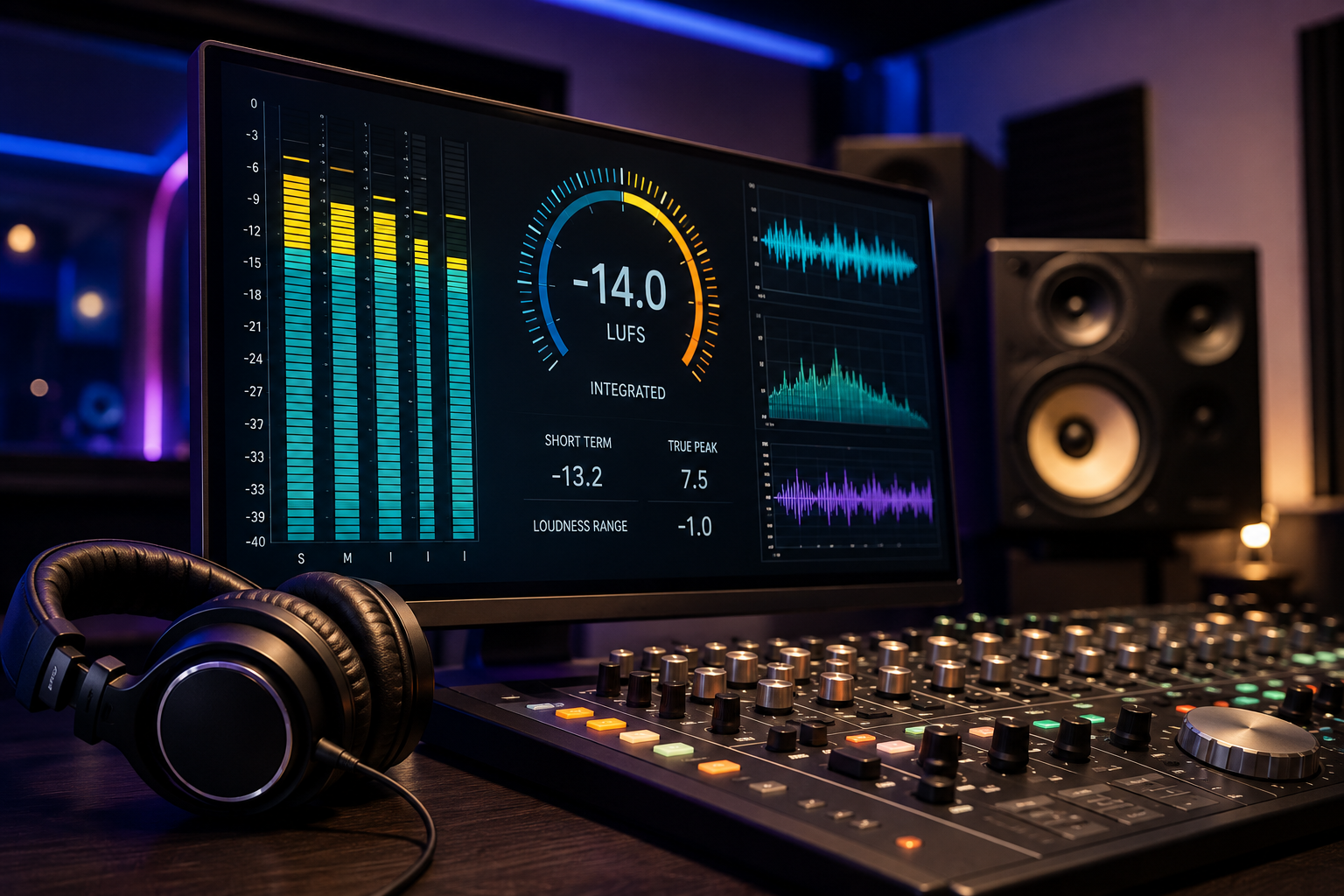
What is LUFS?
LUFS stands for Loudness Units Full Scale. It's the standard unit (defined by the ITU-R BS.1770 specification) that streaming platforms use to measure how loud a track actually sounds to a human ear — not how loud it looks on a peak meter. Unlike a peak meter, which only shows the single loudest sample in a file, a LUFS meter measures the average, perceived loudness across the entire track using a frequency weighting that mimics human hearing.
This distinction matters because two tracks can have the exact same peak level (0 dBFS, for example) and still sound completely different in loudness — one dense and heavily compressed, the other dynamic and open. LUFS is what actually predicts what a listener perceives, which is why every major streaming platform builds its normalization system around it, not around peak level.
What is LUFS Used For?
Streaming platforms use LUFS to solve one specific problem: inconsistent volume between tracks. Without normalization, a quiet acoustic song and a heavily compressed pop single would play at wildly different volumes back to back, forcing the listener to constantly reach for the volume knob. So platforms measure the integrated LUFS (the whole-track average loudness) of every upload and apply a gain adjustment at playback to bring it to a consistent target — this is called loudness normalization.
Importantly: the platform doesn't alter your actual file. It only adjusts the playback volume in the stream. Your master stays exactly as you exported it — the platform just turns the fader up or down when it plays.
Why Does Every Platform Have a Different LUFS Target?
Each platform sets its target based on its typical listening environment and content type:
| PlatformTarget (Integrated LUFS)Behavior | ||
| Spotify | ‑14 LUFS | Turns down louder tracks; boosts quieter ones (within limits) |
| YouTube | ‑14 LUFS | Turns down louder tracks only; does not boost quiet ones |
| Apple Music | ‑16 LUFS | Boosts quiet tracks via Sound Check; slightly more conservative |
| Tidal | ‑14 LUFS | Turns down only, similar to YouTube |
| Amazon Music | ‑14 LUFS | Requires ‑2 dBTP true peak specifically |
| Deezer | ‑15 LUFS | Sits between Spotify and Apple Music |
| Podcasts (general) | ‑16 LUFS | Speech-focused targets are quieter than music |
| Broadcast / TV (EBU R128) | ‑23 LUFS | Built for a quiet living-room environment with wide dynamics |
Streaming music targets cluster around ‑14 LUFS because phones and earbuds are usually used in noisier environments (commutes, gyms, streets), so a denser, more consistent signal translates better. Broadcast standards stay much quieter because they're designed for controlled home listening where sudden loud passages would be jarring. There's no single "correct" number — each target reflects the environment and device the content is actually consumed on.
How Do Platforms Actually Manipulate Your Music's LUFS?
Here's the mechanism, step by step:
- When you upload a track, the platform measures its integrated LUFS.
- It compares that number to its own target (e.g., ‑14 LUFS for Spotify).
- If your track is louder than the target, the platform reduces the playback gain — so a track mastered aggressively at ‑8 LUFS gets turned down by around 6 dB on Spotify. You keep all the pumping and distortion from over-limiting, but you don't get any extra perceived loudness — it plays back at the same volume as everyone else.
- If your track is quieter than the target, some platforms (Spotify, Apple Music) boost it up — but usually only within the track's available headroom, not infinitely. Other platforms (YouTube, Tidal, Amazon) simply don't boost at all — a track mastered at ‑20 LUFS will genuinely play quieter than tracks around it there.
What This Means for Your Master
The old "loudness war" — mastering as loud as physically possible to stand out — no longer works on normalized platforms. It doesn't make your track louder; it only adds the side effects (pumping, distortion, reduced dynamics) while the platform pulls the playback level right back down anyway.
The practical takeaway: master to roughly ‑14 LUFS integrated with a true peak ceiling of ‑1 dBTP (this leaves headroom for lossy encoding, which can create inter-sample peaks above 0 dBFS). This single master plays back correctly, un-touched, on Spotify, YouTube, Tidal, and Amazon, and is only turned down by about 2 dB on Apple Music — which causes no audible harm.
Want a professional master that hits the right LUFS target for every platform? Order online here →