What is EQ and What Are Its Types?
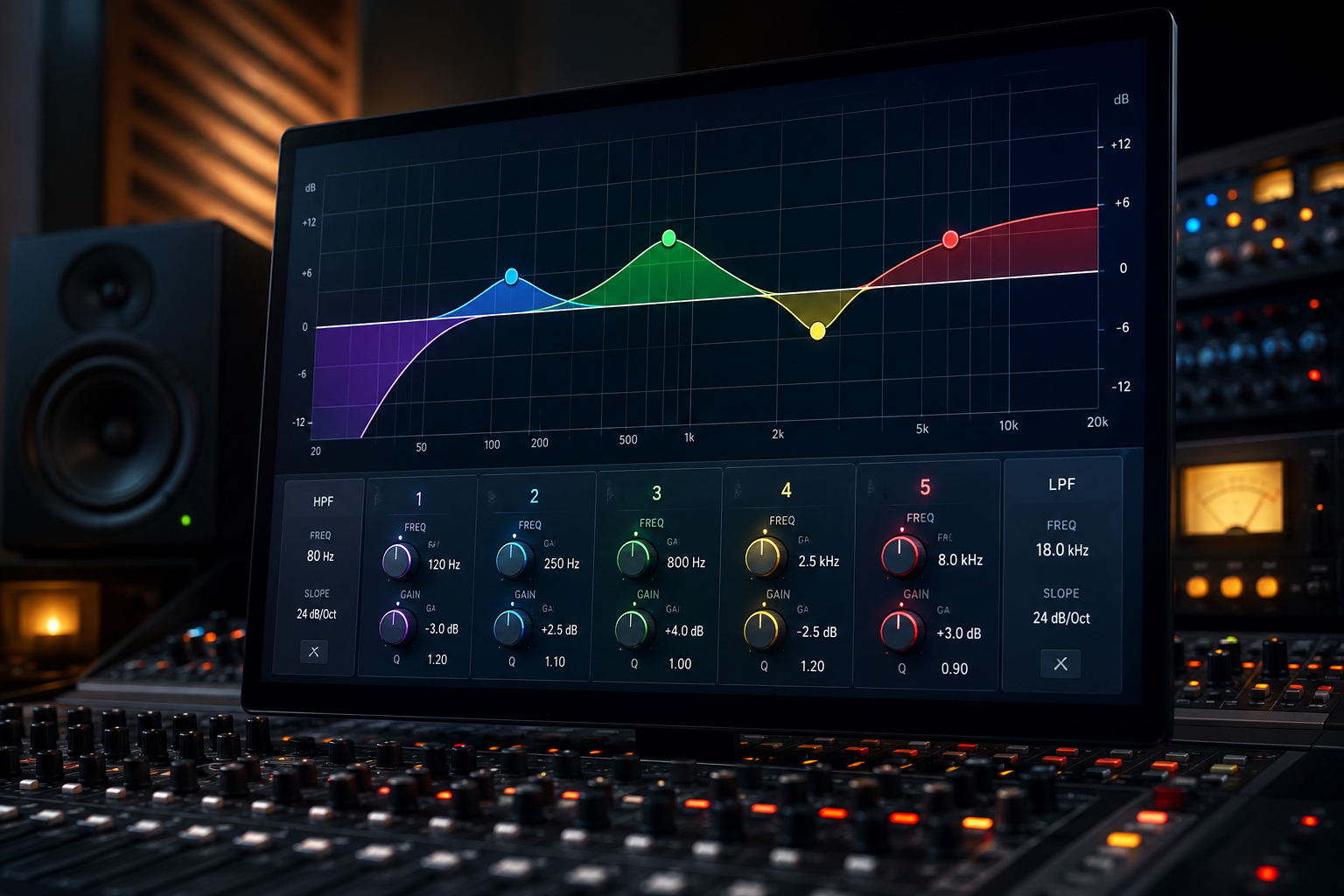
What is EQ and What Are Its Types?
EQ (Equalization) is the process of adjusting the volume of specific frequencies within a sound — boosting some, cutting others — to shape its tonal character. Every sound, from a vocal to a kick drum, is made up of many frequencies at once. EQ lets you reach into that frequency content and sculpt it: remove what's unwanted, emphasize what makes the sound work, and carve out space so different instruments don't compete for the same frequency range.
What Does EQ Actually Do?
Think of a mix as several instruments each occupying their own space in the frequency spectrum — bass and kick living in the low end, vocals and guitars often fighting in the midrange, cymbals and air living up top. When two elements overlap too much in the same frequency range, they mask each other, and the mix sounds cluttered or muddy. EQ is the tool that resolves this: cutting a frequency in one instrument to make room for another, or boosting a frequency to bring out a quality already present in the sound (like the "presence" of a vocal or the "click" of a kick drum).
The Main Types of EQ
1. Parametric EQ
The most flexible and widely used type. It lets you control three things independently for each band: the center frequency (which frequency you're targeting), the gain (how much you boost or cut it), and the Q (how wide or narrow the affected range is). This precision makes parametric EQ the standard choice for detailed mixing and mastering work.
2. Graphic EQ
Uses a fixed set of frequency bands (commonly 10, 15, or 31), each with its own fader that only controls gain — frequency and bandwidth are fixed. It's less surgical than parametric EQ but faster and more intuitive for broad tonal adjustments, and it's still common in live sound and PA systems.
3. Shelving EQ
Instead of targeting a narrow frequency, a shelf boosts or cuts everything above (high shelf) or below (low shelf) a chosen frequency point, like a "shelf" the gain sits on. This is the tool for broad tonal moves — brightening a whole mix's top end or warming up the low end — rather than surgical fixes.
4. High-Pass and Low-Pass Filters
A high-pass filter (HPF) removes everything below a chosen frequency, commonly used to clear out unnecessary rumble or mud from vocals and instruments that don't need low-end content. A low-pass filter (LPF) does the opposite, removing everything above a chosen frequency — often used to tame harsh high-frequency content or create a "distant" or "telephone" effect.
5. Dynamic EQ
Combines EQ with compression: it only applies gain reduction (or boost) to a frequency band when that frequency crosses a certain level, rather than all the time. This is useful for problems that only happen sometimes — like a vocal that gets harsh only on certain loud notes.
When to Use Which Type
- Corrective EQ (removing problems: resonances, mud, harshness) → parametric, with a narrow Q
- Broad tonal shaping (brightness, warmth) → shelving EQ
- Removing unnecessary low or high content → high-pass/low-pass filters
- Inconsistent frequency problems → dynamic EQ
- Fast, intuitive adjustments in a live setting → graphic EQ
Conclusion
EQ isn't one single tool — it's a family of tools, each suited to a different kind of decision. Understanding the difference between parametric, graphic, shelving, filtering, and dynamic EQ means you reach for the right tool for the actual problem in front of you, instead of using one EQ type for everything and hoping it works.
Want your mix EQ'd with precision by a professional engineer? Order online here →