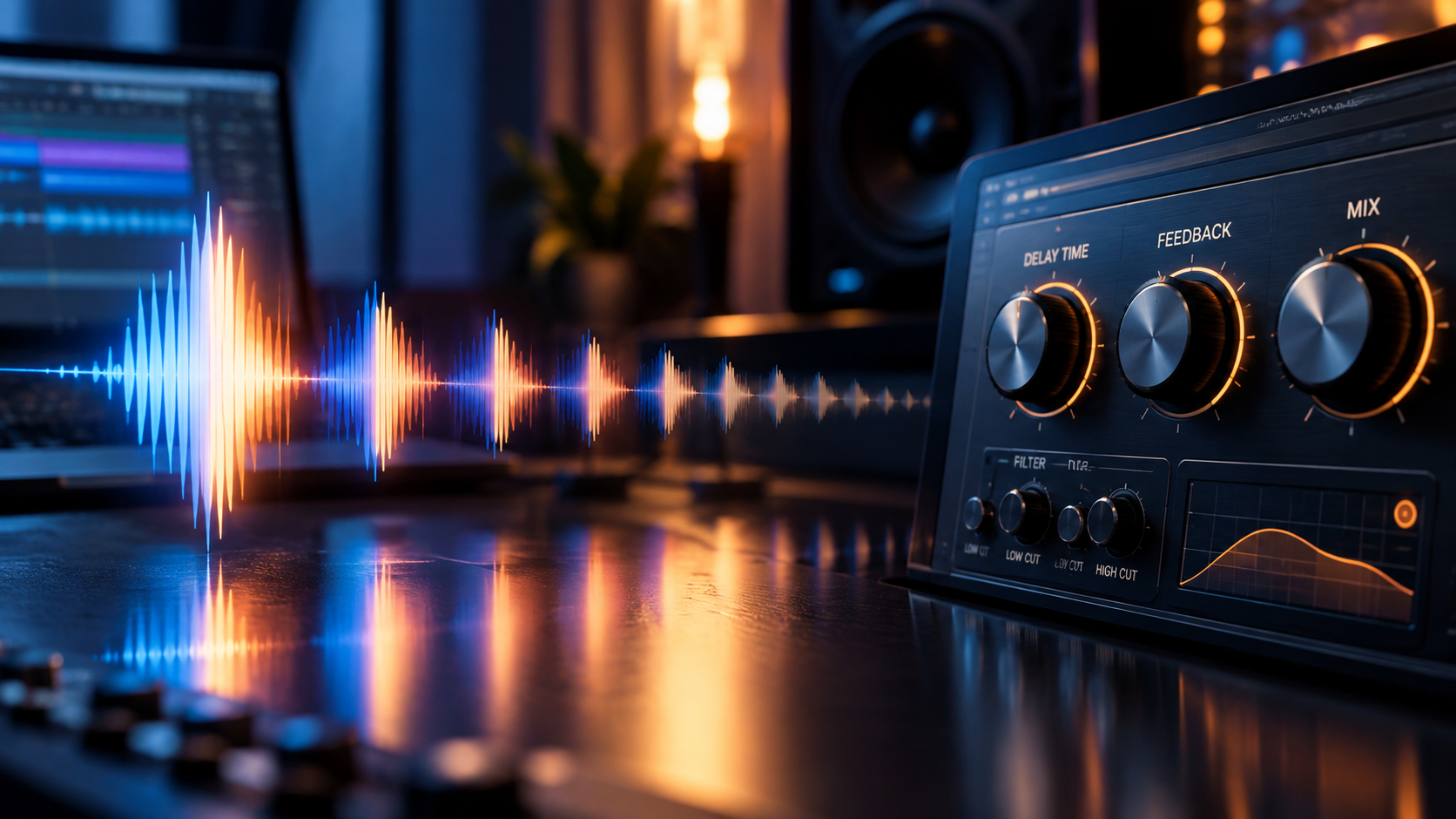
What is Delay and How Is It Used in Mixing?
Delay is an effect that records a sound and plays it back again after a set amount of time, creating a distinct, repeated echo of the original signal. Unlike reverb, which simulates the dense, continuous reflections of a physical space, delay produces one or more clear, separate repeats — you can often count them individually. It's one of the most versatile tools in mixing, used for everything from subtle depth to dramatic rhythmic effects.
How Is Delay Different From Reverb?
This is one of the most common points of confusion for beginners. Reverb simulates thousands of overlapping reflections bouncing around a room, blending into a continuous wash of sound that gives a sense of physical space. Delay produces distinct, separated repeats of the original sound at set time intervals — you hear the original hit, then a clear echo (or several), rather than a smooth wash. Many mixes actually use both together: a short delay to add rhythmic interest and a touch of reverb to glue everything into a shared sense of space.
The Core Parameters of Delay
Delay Time
How long the gap is between the original sound and its repeat, usually set in milliseconds or, more commonly, synced to the song's tempo using note values (quarter note, eighth note, dotted eighth, etc.) so the echoes land musically in time with the track.
Feedback
Controls how many times the delay repeats before fading out. Low feedback gives one or two subtle echoes; high feedback creates a long trail of cascading repeats.
Mix / Wet-Dry Balance
How loud the delayed signal is relative to the original (dry) signal. This controls how noticeable the effect is — subtle for depth, prominent for an obvious rhythmic effect.
Filtering
Many delays include built-in EQ or filtering on the repeats themselves, often rolling off high and low frequencies on each repeat so the echoes sit behind the original sound instead of competing with it in clarity.
Common Types of Delay Used in Mixing
Slapback Delay
A very short delay (typically 60–120ms) with little to no feedback, creating a single, tight echo. Classic on vocals and guitars for adding a sense of thickness and presence without an obviously "echoey" quality.
Tempo-Synced Delay
Delay time locked to the song's BPM using musical note divisions, so repeats land rhythmically with the track instead of drifting out of time. This is the standard approach in almost all modern genres.
Ping-Pong Delay
Alternates each repeat between the left and right stereo channels, creating a bouncing, spatial effect that adds width and movement, commonly used on leads, vocal ad-libs, or synths.
Dotted/Triplet Delay
Uses a musically offset note value (like a dotted eighth note) instead of a straight subdivision, creating a rhythmically complex, cascading pattern that's especially common in electronic and pop production for adding energy and movement to a vocal or lead line.
Where Delay Is Commonly Used
- Vocals — adding depth, rhythmic interest, or filling space during sustained notes and pauses
- Guitars — slapback for thickness, longer synced delays for atmospheric or ambient textures
- Vocal ad-libs and background elements — creating width and movement without cluttering the main vocal
- Lead synths and melodic lines — adding rhythmic complexity and a sense of scale
A Common Mistake
Overusing delay — especially with high feedback and no filtering — quickly clutters a mix, smearing transients and making vocals or instruments harder to understand. Delay works best when it supports a specific moment or texture, not when it's applied uniformly across everything "to make it sound bigger."
Conclusion
Delay isn't just an echo effect — it's a precise tool for adding rhythm, depth, and space in a way reverb can't replicate. Understanding delay time, feedback, and filtering gives you control over exactly how present and rhythmic that repeated sound feels, instead of relying on a generic preset and hoping it fits.
Want your vocals and instruments treated with tasteful, professional delay and space? Order online here →