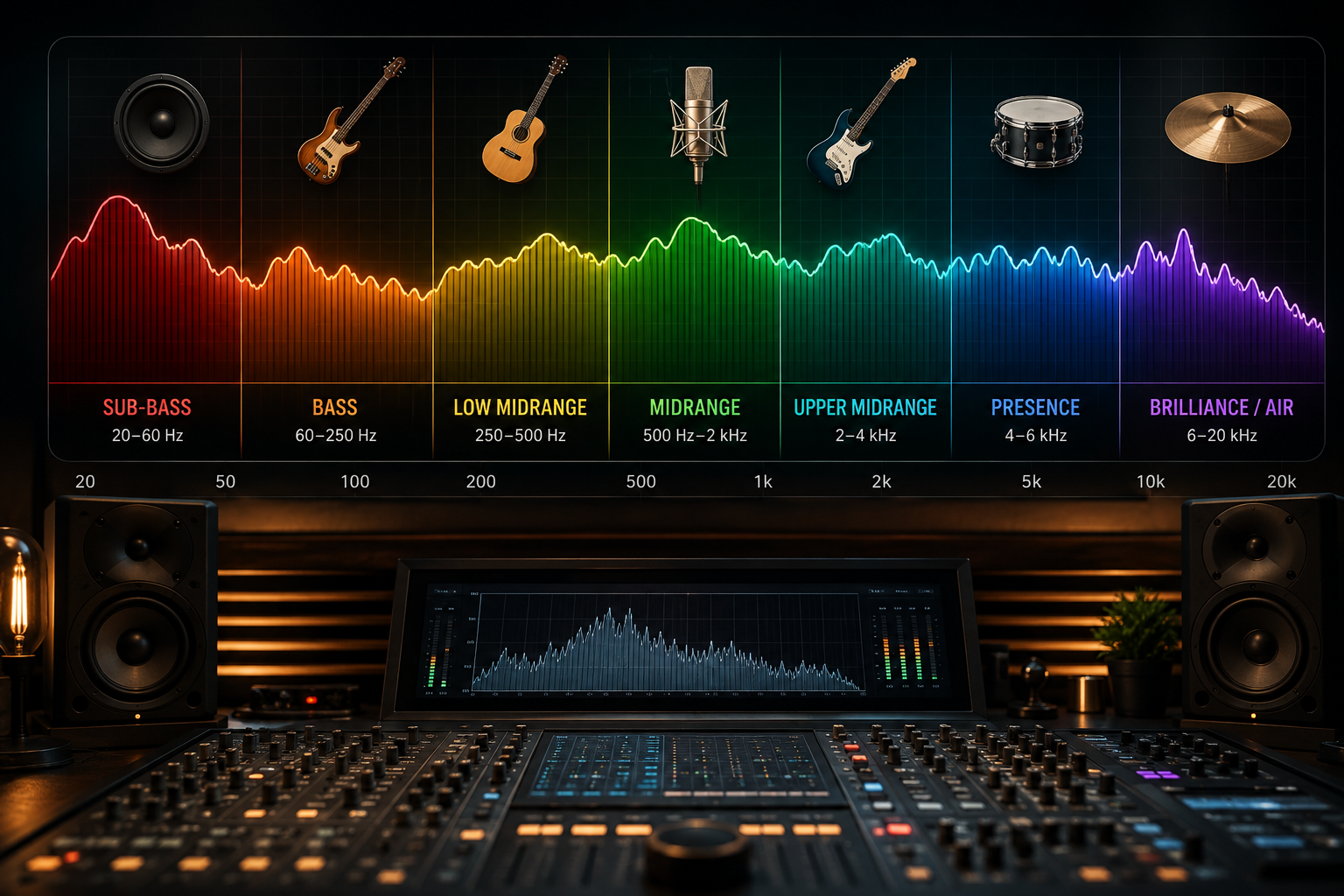
The Complete Guide to the Frequency Spectrum: Bass, Midrange & Treble in Mixing
Every sound you hear in a mix is made of frequencies measured in Hertz (Hz) — from the deepest sub-bass rumble to the highest cymbal shimmer. Knowing roughly what lives where in this spectrum is one of the most useful pieces of practical knowledge in mixing: it turns "make it sound better" into a specific, targeted decision about a specific frequency range.
Sub-Bass (20–60 Hz)
This is the lowest range humans can hear — felt more in the chest than heard clearly through most speakers. Kick drums and 808s often have their fundamental energy here. Too much content in this range makes a mix feel heavy and undefined on small speakers; too little makes it feel thin on a proper sound system. Most of this range is inaudible on phone speakers, so it should never carry information essential to understanding the song.
Bass (60–250 Hz)
This is where the punch and warmth of bass instruments and low male vocals live, along with the body of kick drums. This range is also where "muddiness" most commonly builds up — when a bass, a kick, and a low guitar or synth all pile into the same 100–200 Hz pocket, the mix loses clarity and definition. Careful EQ decisions here (deciding which instrument "owns" which part of this range) are often the single biggest factor in a clean low end.
Low Midrange (250–500 Hz)
This range carries the fullness and body of most instruments, but it's also where boxiness and a "cardboard box" quality build up if too much energy accumulates. Many mixing engineers make small cuts here on multiple instruments simultaneously to open up space without any single element sounding thin.
Midrange (500 Hz – 2 kHz)
This is arguably the most important range in the entire spectrum, because it's where the human ear is most sensitive and where most of a song's melodic and harmonic information sits — vocals, guitars, snares, and most lead instruments. Problems here are the most noticeable to a listener; this is also the range most prone to masking, where instruments genuinely fight for the same space.
Upper Midrange (2–4 kHz)
This range controls presence and clarity — a vocal boosted here feels closer and more forward in a mix; a guitar boosted here cuts through more easily. It's also where harshness and listening fatigue build up if pushed too far, since the ear is extremely sensitive in this zone.
Presence (4–6 kHz)
This range adds definition, articulation, and the sense of "clarity" or "intelligibility" to vocals and instruments — the difference between a vocal that sounds close-up and detailed versus one that sounds distant or buried. Too much here creates a sharp, sibilant quality, especially on vocals (the source of harsh "S" sounds).
Brilliance / Air (6–20 kHz)
This is where the shimmer, sparkle, and "air" of cymbals, high-frequency vocal detail, and the overall sense of openness in a mix live. A gentle boost here can make a mix feel more polished and expensive-sounding; too much creates harshness and listening fatigue over time.
How to Actually Use This
This chart isn't a rulebook — it's a map for diagnosis. When something in a mix sounds "muddy," "harsh," "thin," or "buried," you can now ask a specific question: which range is this actually happening in? That question turns a vague feeling into a targeted EQ decision, instead of randomly turning knobs and hoping something improves.
Conclusion
Understanding the frequency spectrum doesn't replace your ears — it gives your ears a vocabulary and a map. Once you know roughly where mud, harshness, presence, and air actually live, every EQ decision becomes faster, more confident, and more precise.
Want a mix with a clean, well-balanced frequency spectrum from top to bottom? Order online here →